
Why Reassurance Makes OCD Worse
Have you ever asked someone, "Are you sure everything is okay?"—only to feel relieved for a few minutes before the doubt came right back? If so, you aren't alone. For people with OCD, reassurance can feel like the solution, but it's actually one of the things that keeps the cycle going.
One of the trickiest things about OCD is that before someone truly understands what they are experiencing, they may unknowingly act in ways that make their anxiety worse. Reassurance-seeking is an extremely common compulsion and can come in many forms.
There is also a counterintuitive aspect to it. If someone feels worried or anxious about something, it is natural to want to gather more information to ease that anxiety. Maybe that looks like researching something or asking someone you trust what they think. Outside the context of OCD, this is a completely rational reaction. However, when OCD convinces you that even a tiny possibility of catastrophe must be ruled out, that search for information turns into an obsessive endless need for certainty.
Why Does Reassurance Make OCD Worse?
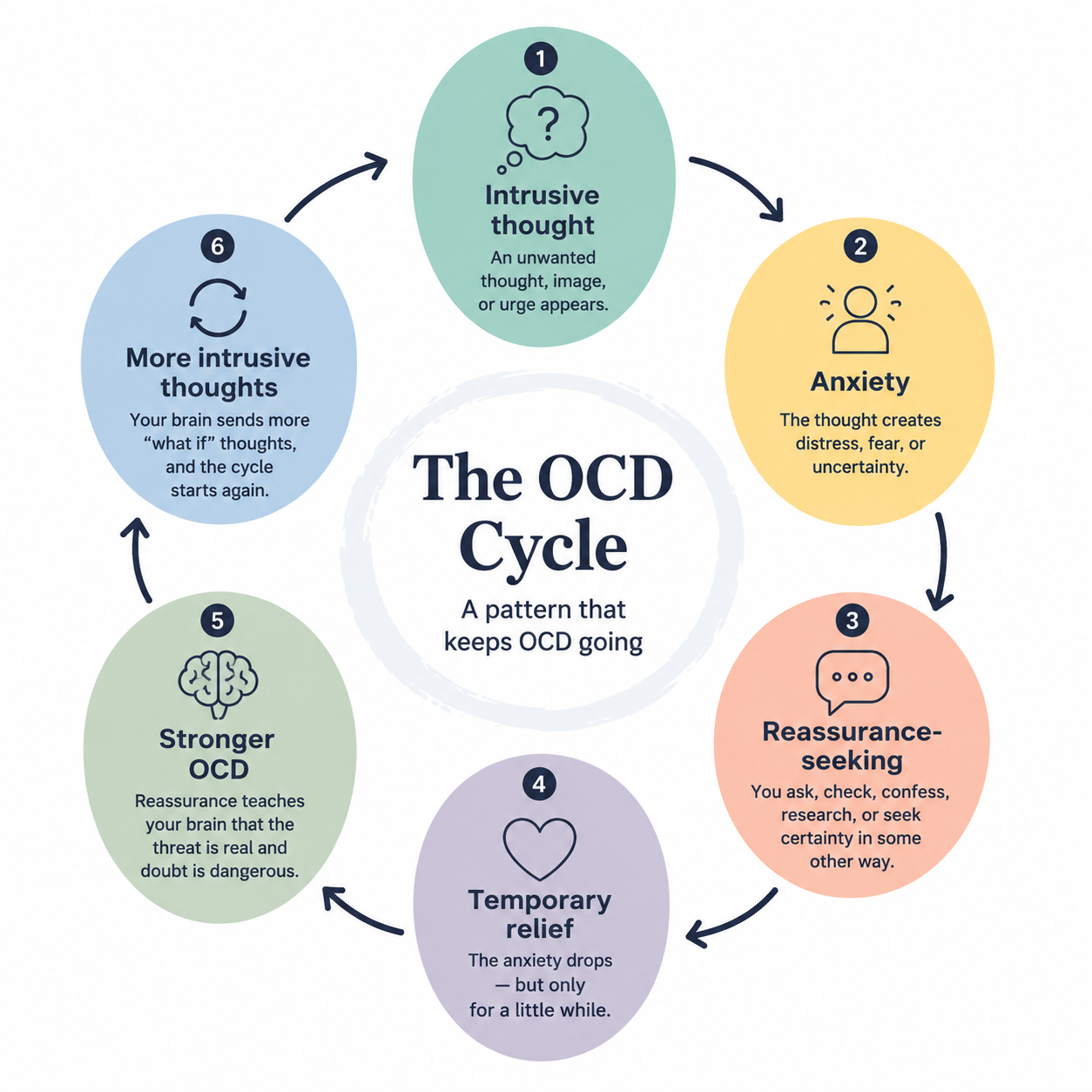
While reassurance can bring temporary relief, it teaches your brain that uncertainty is dangerous—and that lesson is exactly what keeps OCD going.
OCD thrives on doubt- that “what if” question. Any action taken to feel certain about something ultimately fuels the doubt. It feeds the possibility that this thought, symptom, or situation really is dangerous after all. Every time you seek reassurance, your brain learns a lesson: asking or checking provides temporary relief, which reinforces that behavior, and then the worry/fear feels more legitimate, more “real.” Instead of teaching your brain, "That thought wasn't important," reassurance teaches it, "Good thing we checked." That keeps the alarm system turned on.
Consequently, your brain becomes more likely to send the same intrusive thought again. Over time, reassurance may provide less and less relief, leading you to seek it more often and from more places.
Common Examples of Reassurance-Seeking
Reassurance-seeking isn't always obvious. Here are examples I hear often:
“I locked the door, right?” “Are you sure the stove is off?”
“Do other people experience this? Is this normal? Is this common?”
Asking your partner or friends if “everything is ok” repeatedly
Checking Reddit to see if others have the same thoughts
“Did you see anyone crossing the street? You don’t think I hit someone, right?”
Googling symptoms repeatedly, or checking in with your doctor/multiple doctors
Rereading text messages or emails repeatedly
A variation of reassurance-seeking that’s important to recognize is confessing. Seeking reassurance doesn’t always come in the form of a question. Sometimes a statement can be made, such as telling a trusted person about an intrusive thought, to see how they respond. The reassurance becomes evaluating their reaction to see how serious or “real” the thought is.
Very often, OCD isn’t just affecting the person who experiences it, and reassurance-seeking plays a big role in that. It’s completely natural for those who care about you to want to help by answering questions or offering reassurance. While this comes from a place of care, repeatedly providing reassurance can unintentionally strengthen OCD over time. Learning new ways to respond can be an important part of recovery.
How ERP Helps Break the Cycle
The good news is that reassurance-seeking (and other compulsions) don’t have to control your life forever. Learning to recognize reassurance-seeking as a compulsion—and gradually resisting the urge to seek certainty—is one of the most effective ways to break the OCD cycle.
Recovery isn't about becoming certain. It's about becoming willing to live with uncertainty without letting OCD dictate your behaviors. With effective evidence-based treatment, it is possible to step out of the OCD cycle and regain confidence in your ability to tolerate uncertainty.
If this sounds familiar or you’d like to learn more about effective treatment for OCD, I'd be happy to talk with you about how Exposure and Response Prevention (ERP) therapy can help.
